 Brave New Word is a brand new theatre company. There's quite a few of them about. It sees its mission as to 'cultivate the visions of new Australian writers'. A dirty job, but someone's got to do it. No, no. C'mon. Be serious. This outfit really does have a distinctive, niche philosophy.
 We are dedicated to producing and performing original Australian text-based works, with every project undergoing a development process with the cast, creative team and writer before moving into rehearsals.
Open-endedly collaborative. Just like the ALP. No, no. C'mon. Be serious.
Body Language is Brave New Word's very first show and, I have to confess, as this review is running behind schedule, as I write, there are only a few more nights left in the season. Being the company's first 'entirely original' work, it's the first of its productions to be subject to this egalitarian process. The script is by Luke Holmes (who is also BNW's artistic director, as well as being responsible for lighting and sound design, such as it is), but was given over to workshopping, involving writer, director Sepi Baghaei, cast and 'creatives', for the first three weeks of rehearsals. The ethos being nothing is sacred, or set in stone.
The feedback loop is designed to optimise the script for the actors' individual and interactive propensities. So something is constructed, deconstructed and reconstructed. And everyone shares in the process, to promote a going sense of ownership. Intriguingly, too, the whole company is comprised of a cabal of AADA (Australian Academy of Dramatic Art) graduates.
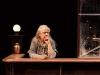
Whether it proves to be the company's residence remains to be seen, but this production was staged at 107 Projects, a multifarious space at the same address on Redfern Street. The theatre is really more like a garage: brick walls; concrete floor. There's a sturdy concrete pillar off to one side, which presents sightline issues, as does the loose arrangement of various, born again armchairs, lounges and upright, waiting room numbers. Get there early and get a good seat, or it's every man and woman for themselves.
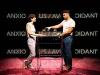
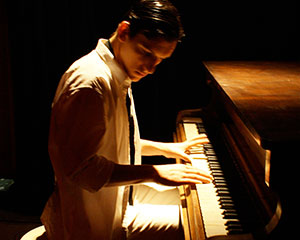
The premise of the work is to poke, prod, probe and microscopically examine the fraught terrain of human relationships. A thread woven through a series of vignettes is the boy-girl choreographic drama played out by Paul Musumeci (who provides keyboard and other musical effects) and Lillian Jean Shaddick. It's one of those things that arguably looks better on the page than on the stage. Nonetheless, when it's not clunky and clumsy (which it sometimes is), it sports a kind of brutal sensuality that's quite engaging. If push came to shove, one might even mount a case for clunky, clumsy choreo as a metaphor for nascent forays between would-be lovers, I s'pose. It's probably just a case of being undercooked: with work, I think this could even become a company trademark, if you will.
First, we meet Jake and Elise. Both are writers and ex-flat or housemates. The sexual tension between them is almost immediately apparent: a compliment to the efficacy of both script and actors. They've collaborated on a story (or the seed for one) and we enter into the Holme's constructed universe, in which the gravitational pull between people is rocked by power struggles that emulate the Newton's third law: (to paraphrase) for every action, there is an equal and opposite reaction. They bicker, as a distraction from their true, undisclosed feelings, about who wrote what. Jake is trying to pitch the concept as a novel, while struggling, in vain, to complete it. When they were together, he was making progress but, now they're living separately, he can't knuckle down. Elise's version is a screenplay. Same idea. Different page. Just like the space between them; equivalent to a Venn diagram, in which there are overlaps, but vast areas of divergence. She's got a new guy; not that Jake was ever her 'guy'; but the prospect clung to them like a spectre dipped in honey.
Travis Kecek, Nicole Dimitriadis (also dramaturg) and a well-observed script exude these tensions palpably. Kecek, particularly, has a bouncy, anxious charisma and a capacity for naturalism that can't really be trained-in. The glamour of the text is it looks through the prism of the creative process as a metaphor for the 'delicate balance of power', all too rarely acknowledged, let alone articulated, that exists in all relationships. The success of the relationship's 'script' relies on a kind of implicit, notional agreement about boundaries; unspoken rules and regulations which, if trespassed, can result in total collapse. It's a conceit that rings chillingly true and is related with a pronounced, credible realism. Between Jake and Elise, the ship of possibilities is suddenly all at sea when one becomes jealous of the other's success. Or boyfriend. Collaboration turns to competition and there are foreboding oscillations which shake the fragile hull they've built. It's a ripple that magnifies and rocks the boat to the point of capsize. It's relatable, inasmuch as we've surely all had the experience of the 'if only' relationship. If only I wasn't married. If only he wasn't gay. If only she was ten years younger. If only he wasn't my boss. And so on. Consonance and dissonance, if calibrated less than optimally, spell iceberg. It's a platform for comedy, but also some tangible poignancy. There's also a poetic thread, in its oblique thesis as regards the pseudo-sexual excitement that resonates from a powerful idea or creative initiative. The scenario and its explication is by no means exemplary, but it's heart and soul is in the right place. If it'd been delivered with more confidence (and this is true of the whole production), it would have nailed audience attention firmly to the mast.
By a deft linkup of sliding doors and temporal tampering, we're also introduced to Nick (William Koutsoukis), Elise's new boyfriend in the first vignette (if I've recalled the order correctly), but one who emerges as a troubled man on the rebound, in a shrink's rooms inflamed with jealousy of the kind of intimacy and understanding shared between Jake and her, that he beat Jake to a quivering, hospitalised pulp. He was wrong about them. And he was right. But God knows, Nick's got his own problems. By means we know not, he's inherited a fortune, but this is as nothing, thanks to his ongoing infatuation with Elise, who jilted him, we're led to understand, on the basis of his merciless, psychopathic assault on Jake. Seeing the shrink seems to be a condition of parole. He's still in love, or co-dependency, or one-sided dependency, or something, with Elise, who he worships and lionises. Koutsoukis performance though is too contrived, stiff and mannered to be believable, while Brendan Layton, as Sam, the shrink, seems to cower in the role: he can't seems to summon the kind of gravitas that it implies.
Tilting the narrative another six degrees yields a friendship between Sarah (Charlie Hanson) and Elise. Sarah confides her adoration of an otherwise reclusive man who approached her in a pub (I think), with a flattering offer to paint her portrait. She forms the idea he is captivated by something in her she can't see. His ideation is quite different, as he comes to confess. Karl (David Ross) doesn't see Sarah at all. Instead, he sees the daughter he lost, at a certain age. All his subjects are versions of her. He needs a shrink as much, or more, than Nick does, but finds a more gentle muse, in the process of applying paint to canvas and eking out visions of what might've been, if only. Sarah, too, see what she wants to see, not what it is. Ross is quietly, seethingly effective as the too cool, quietly spoken, complex and conflicted artist.
Meanwhile, the healer (shrink) is sleeping with one of his patients, a high-class hooker named Lara, who also brushes up against Nick. Nick takes a liking to her and ends up giving her all his money in exchange for a favour which will free him and her from Sam's control and interventions.
Much suspension of disbelief is required with regards to some of these characters and their situations, which are histrionic and out-of-step with the plausible banality of Jake and Elise's lot. The key investment seems to be in scrutinising this relationship, with the others orbiting, like slightly off-track satellites, around it. In other words, while J & E's liaison shows few seams, as a whole, the script, performances and production betray careless, hasty stitching.
Brave New Word has made a debut with Body Language that wavers between harmonious and hamfisted. Something tells me the company is capable of more and better. And something tells me they will build it. And we will come.
Brave New Word in association with 107 Projects present
BODY LANGUAGE
by Luke Holmes
Director Sepi Baghaei
Venue: 107 Projects | 107 Redfern St, Redfern NSW
Dates: 19 – 29 June 2013
Times: 8pm Wednesday – Saturday
Tickets: $18 – $15
Bookings: www.trybooking.com/CVFD
Visit: bravenewwordtheatrecompany.wordpress.com/